Showing posts with label Brand Exposure. Show all posts

Sunday, 14 October 2012

Is your Website Mobile Optimized yet?


Nowadays a staggering  9 out of 10 New Zealanders have access to the internet, with the  time we spend online doubling since 2005. And 59% of New Zealanders using the internet are over 35 – its a myth that it is just gen Y surfing the net!
 More and more people are searching the internet and shopping online, particularly on their smartphones.  In 2013, 50% of online traffic will come from mobile devices – smartphones like the iPhone, Android, Blackberry, Windows mobile, Palm Pre). The use of these devices is sky-rocketing with 60% of Kiwis are expected to have a smartphone by the end of this year. Soon enough, all mobile phones will be smartphones.  More people than ever will use their smartphones rather than computers for surfing the internet and shopping. The ‘second screen’ is commonplace in many Kiwi households – people are looking at their smartphones and iPads whilst watching telly, or eating tea.

It is essential to keep up with the technology that your customers are using. Look at a normal website on a smartphone  – the majority look woeful. Most of them look teeny tiny and really hard to navigate - you need to pinch the screen to enlarge everything, and the pages take ages to load! A recently survey showed that 40% of users have turned to a competitor’s site after a bad experience trying to search an un-optimized website on a smartphone.

If you have website, optimizing it for mobile use is imperative.  People who are shopping on their mobiles have different needs and expectations than those who are shopping online on their lap top or PC.  They need easier to read pages, and for pages to appear quickly. They are searching for specific items, the information accessed on their on mobile needs to be easily searched and accessed. They are looking for specific makes and models, information on the makes and models that dealership has for sale, as well as dealer contact details. If your dealership does not have a mobile website, you are missing out on potential leads and sales.
As well as when people are at work or out of their office or homes, dealer mobile website use increases at weekends, when people are out and about doing the rounds of yards on a weekend. These shoppers are far along the car buying process, they will have a make, model, year and budget in mind.  The easier it is to access information about your stock on a smartphone, the more likely you will get leads and walk-ins. People’s attention spans these days are short! If someone is searching for a specific vehicle on a website that isn't mobilized  it is harder to see and access and the consumer is likely to just give up and move on to another dealer’s website that is mobile and easily accessible.

Functionality that your Mobile Website needs

1.       Good search options
The more search criteria on mobile websites, the better, i.e. Body style, make & model, price, mileage, transmission cc-rating etc.

      
2.       Vehicle Features and Description
Easy access to your vehicle’s features and your description and information about the vehicle is vital.
  
3.       How to find you
Address details, contact details and a map are key for mobile websites, so your buyers can easily find you!
4.       Easy dealer contact
The ability to find your phone number or contact you by email is important. Another valuable feature is automatic dialing  when a person can click on the salesperson’s number and have the phone ring it automatically making your dealership easily accessible.
We began to build mobile websites for our clients last year, and we have found a huge increase in leads and enquiries coming directly from dealer’s mobile websites
Mobilising your website will make it easier for customers to search your stock, find your yard and make contact.  
   
If you have a dealer website – you should have that website made ‘mobile’. People also generally prefer mobile websites to Apps, as mobile websites are easier to find – if someone clicks on your website URL on a mobile phone and you are mobile optimized, the mobile site will load automatically. 

The good news is that it is not too difficult to optimize your website for mobile.  Many local businesses provide mobile website builds, so ensure you don’t get left behind.


Monday, 10 September 2012

Get your stock moving with Video


Selling cars isn’t easy, and the internet has made it challenging for dealers to distinguish themselves. From a buyer’s perspective, another dealership is just a click away. Dealers need a way to immediately capture the customer’s attention and differentiate themselves from their competition, online video is one of these ways.

No other marketing medium creates emotional attachment like video can. Whether you’re selling a house, car or a widget, video helps you merchandise at a whole new level.

In October, Trade Me Motors will be implementing a new video technology called AutoReel. This automatically creates a simple video presentation for participating dealers’ cars for sale on Trade Me Motors. AutoReel stitches together the photos of the vehicle, and adds an automated audio voice-over created from over 2,500 pre-recorded phrases. We think it is going to be a great way for dealers to stand out from the crowd.

The process is all automated, so the good news is that dealers don’t need to do any additional work to create the AutoReel presentations and have them bolted onto their Trade Me listings. Check out a Demo of this product here.

"Watching video content on computers has become just as common as watching video content on television among online consumers" 
Dazzz Wiltshire, Trade Me 

According to Nielsen’s global survey of multi-screen media usage, watching video content on computers has become just as common as watching video content on television among online consumers. More than 80 percent of Internet respondents in 56 countries reported watching video content at home on a computer (84%) or on TV (83%) at least once a month. By contrast, in 2010, more online consumers reported watching video content on TV (90%) than on a computer (86%) in a month-long period.

Back home in New Zealand, Nielsen also tells us that over 73% of Trade Me’s audience use YouTube, justifying that online video is just as popular here as well. As video consumption becomes part of everyday life, it should be no surprise that consumers prefer the use of video in product evaluation and selection, and that includes when shopping for a used car.

So why video, and what makes a product like AutoReel so special compared to a well-constructed static car listing?

Different - It sets you apart from other dealerships and means your listings will potentially appeal to a larger audience. Not all your visitors prefer to receive content using text alone, and AutoReel means they will now have the option to watch, listen and read at the same time.

Videos are "sticky" AutoReel is a way to make information more interesting. Video engages visitors’ senses more than text, and is likely to attract more vehicle viewings encouraging visitors to look longer at your listings. This helps build long-term relationships with your visitors which can lead to more sales.

The use of video online is exploding – and if a picture speaks 1000 words, then video must be worth a million.  Can you afford not to be involved?

Please contact us here for more. 

Wednesday, 13 June 2012

Automation doesn’t beat the human touch


I’ve noticed a change is dealer listings lately. Part of my job is to look at listings day in day out, and here at AutoBase & Trade Me I think it’s safe to say we’re pretty versed in what makes a good listing. The proof is in the pudding – good listings get more views, and this information is available to us and all of our clients. Lately I’ve noticed a couple of trends on listings, and they seem to originate from listings being purely automated, with no human input.  
It’s not all about you
The first trend that dealers are cramming their listings full of information about their yard, with very little about the vehicle for sale. Some Vehicle Management Systems allow you to duplicate standard text about your dealership automatically to every listing. It is definitely great to include information about your yard, such as hours, deals, finance options etc – but it should be a balance so make sure you are also adding enough information about the vehicle for sale for potential buyers to search for, and find. People are looking for specific vehicles, and when you come across a listing for a vehicle you like the look off which has little or NO information about that vehicle – it puts you off and you move on to the next. It’s simply just annoying.  For example:
Private Sellers work the system
We know that listings with about half about the car and half about the yard work well. Last year we published an article about privates vs dealers. Privates Private sellers make up 70% of used automotive sales, dealers 30%.  As we see it, there are 3 main factors that distinguish private sellers from dealers that in reality, dealers should be up to play with. Time, Motivation and Emotion. Private sellers spend the time to put blood, sweat and tears into their listings with loads of information about the vehicle for sale. They only have 1 vehicle to sell so can put everything into it.  They will think of every single benefit and feature to mention in their listing to promote their vehicle. It sounds basic, but so many dealer listings lack much of the following information that privates do so well:
·         Selling points
·         Why are they selling
·         How does the car run
·         Prior maintenance
·         Mention modifications
·         Highlight good mileage
·         Highlight special features
Private sellers also tell a story about how great the vehicle has been, how well it runs, and how well they have looked after it. This is what potential buyers want and need to know. A listing with just “Black Ute, 4 wheel drive” in the comments is not going to motivate a potential buyer to contact that yard – there are plenty better listings available at the tip of their fingers to look at.
No info – no sale
People like to use classified sites such as Trade Me because it is easy to search for exactly what they want. My friends and I tend to plug in a keyword into one of the search bars, and go from there e.g. “economical automatic Toyota”, “black Suzuki Swift” or “X5 leather interior”.  Recently I watched a friend search online for a Mazda Atenza.  He was particularly interested in a leather interior. He did a search based on price, year, transmission and KMs. The first Atenza he found was from a local dealer, but only had only 2 images (both exterior), no features and hardly any information about the vehicle, let alone any information about the interior. He grunted and clicked onto the next listing. I asked him why he didn't just contact the dealer to ask for more information about that particular vehicle - he said he couldn't be bothered when there were so many other similar vehicles with more info in his list. That dealer lost a sale and he ended up buying from private seller, who had a listing for a slightly more expensive vehicle, but it showed him everything he wanted.
Keywords Keyword Keywords
If a listing has few keywords or information about the vehicle, it won’t be picked up in some search criteria. We can’t recommend enough that the more keywords you use, the better. Keywords are searched from the top to bottom of your listing on Trade Me Motors - therefore a key word in the features list OR comments 'free flow' section will be picked up in a browser's search. All the keywords below in yellow will be picked up in search results.
Here are some interesting facts:
·         80% of searches include 1 to 3 filters
·         Almost 50% of searches include a keyword
·         49% of viewers search for a car make  
·         Around 41% of searches include a price option. 
The most popular filters used when searching Trade Me Motors are:
1. Make
2. A keyword (e.g. manual, v8, 4x4, leather interior, economical etc)
3. Body style, Price or Year

Another trick to use
Here is a trick that we know encourages people to view tour listings. Instead of just having the Model Detail, this dealer has added *REDUCED* to draw attention to the listing.
You can see for yourself how effective it is at getting attention. You get 25 characters to play with, and they all show up within the search results headline for that vehicle, e.g: ** NZ NEW **, **SPECIAL** or ** Drive Away Price **. Use this information wisely - don't say anything in the headline unless it’s true and relevant to the vehicle being advertised. 
At the end of the day, Vehicle Managements Systems are a great way to get lots of stock loaded quickly but make sure you are reading your listings that are going out, and making sure that they have enough relevant information. Jump onto your classified website and search for your own listings – are they easy to find? There is a lot of competition on the Internet, so make sure you spend a little bit of time and effort to make the best of your listings to stand out from the crowd. You might just make more sales.

Monday, 23 January 2012

QR Tags - What are they all about?


Lately we have had a few enquiries from dealers about QR Tags (or Codes). Namely what are they and should you be using them? You have probably seen these black and white boxes in newspaper ads, on bus shelters and on billboards. QR stands for Quick Response, and anyone with a Smartphone can use QR tags. It is simply a bar code that is read by Smartphones with cameras. (See more about Smartphones here). QR codes were invented by Toyota in 1994 to track vehicles during the manufacturing process, designed to allow the 2 dimensional bar codes to be decoded at quickly. Now anyone with access to the internet can generate a QR code in about 5 seconds.

How do you create a QR tag?
You can easily generate a QR tag using one of many websites. The website will convert a standard URL into a QR code. Once converted, you can download the QR image file and then attach it to your e-mail signature, upload it as a Facebook profile photo, print it or post it elsewhere online. Some QR-conversion sites can also encode maps, text, phone numbers or RSS feeds. QR code-generating sites include Kaywa (below), Qurify and Delivr. I've typed the AutoBase web page into this QR code generator and ticked URL:
I can put this QR code to a brochure and once scanned, it will take the user's smartphone to our website, as below: 
 
How do you get the information from the QR tag?
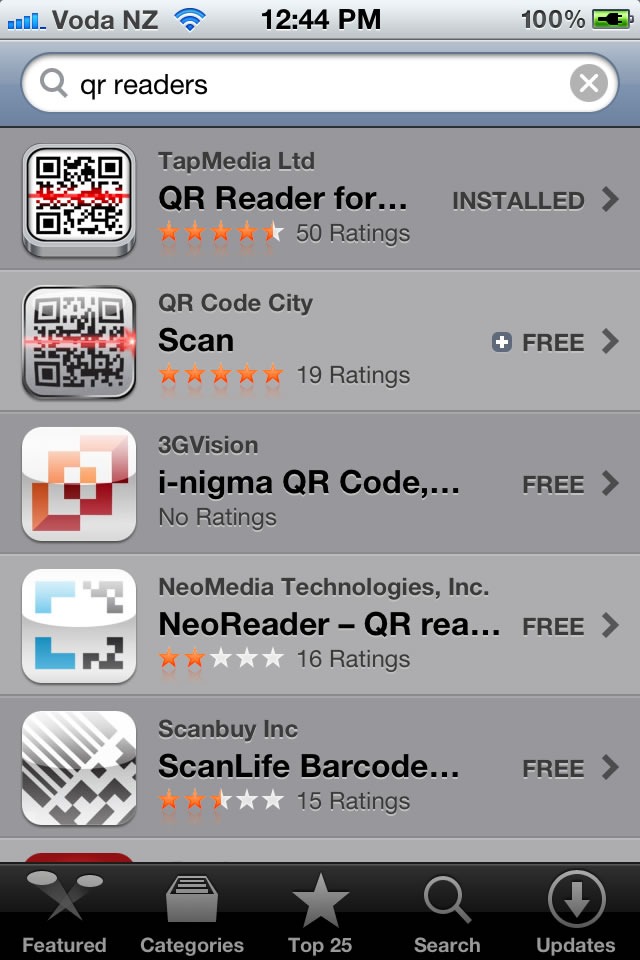
To read a QR tag, you need to download a QR reader on your Smartphone. These are free to download. Here are a few that popped up when I checked the App Store on my phone.
When you see a QR tag, you can scan it using your phone. The QR code will send you to whatever has been coded, i.e. a website, text, a vcard (Outlook contact business card), a text message, a phone number or other data. Here is a listing I'm looking at on my work computer:
I then my scan the QR code in the bottom right corner using my iPhone, as below. 
Once your smartphone scans the QR tag it uses a wireless network to find the hyperlink destination. This doesn't have to be a website - it could be a create a text message or go straight to a phone number, ready to call. When scanned the code above,  my iPhone took me straight into the vehicle listing page, as below, where I can now save the page to my phone for future reference.
 
Why use QR tags?
QR tags are FAST -  instant gratification. Scanning a QR tag gives you information you need immediately, for example you may be on a PC at work, or your laptop. I have scanned QR codes i have seen as bus stops to get information on the event or product the bus stop sign is advertising.  You can scan a QR code on this listing and that listing web page will appear on your iPhone, ready to save and bookmark on your phone.

Where do I put my QR tags?
QR tags can be displayed on a website page, poster, business card, brochure, signage, Facebook, Twitter. In New York, stickers with QR tags are being distributed to bus stop which Smartphone users scan to get immediate bus timetable and traffic status updates.
You could put a QR tag on a vehicle for sale on your yard that takes viewers to that vehicle's website listing. The options are endless, but the most effective way for dealers to use QR tags would be to drive viewers to their online listings or company websites. See QR tags in action on listings and dealer pages on our website www.autobase.co.nz.


Check out this video for more information and advice on how to use QR codes within your dealership.

Sunday, 11 September 2011

The internet is dead, long live the internet!

What are the current internet trends and how are they impacting my business?
 
Understanding the internet and its changing direction is relatively easy. The biggest barrier is the time required to search and read through the mountains of articles, papers and comments. While the internet is huge, within itself it is mainly dominated in the west by a few key and very large players. When on the net you think you are master of your own destination, but behind the scenes the likes of Google and Facebook have a lot to say about what you see and how you find it. In a micro way, Trade Me operates the same way with the presentation of listings based on featuring, listing order and user profile. This being said, the easiest way to spot trends is to follow the major players and their moves.


Presence is a much overused word when discussing the internet, however the reason why is due to the fact that it is very important and the key step to being found. Without a well thought-out strategy on gaining a high profile presence, any online expenditure is wasted. A balance needs to be found between finding the right mass of prospects within a marketplace and then standing out from your competition.  This is where we face the first trend within the internet which is driven by two factors:


1.       Companies marketing on the internet understanding the value of guaranteed product  placement within the first page of a users search


2.       Search engine providers being able to value the first page real estate higher than subsequent results 


Users are under the impression that when they ‘search’ they are searching the entire web, when the reality is that they are searching an indexed database of the search engine provider they have chosen. From this point the results are displayed based on the highest paid bid to the search engine provider and the quality of clicks.  If you Google “Auckland Bars” for example, you will see what I mean. All those bars that have paid Google for advertising are displayed first and down the right hand side.  Next are the bars that have registered with Google Places and last, but not least are the non-paid-for listings which are termed “organic”.  This trend is growing throughout the web and online market places and to be on the first page you need to pay more, however the positive side of this is that it guarantees you high quality presence.
 
Community is nothing new as a concept and as humans we love to feel that we belong.  In a setting that we belong to, we feel trusted, share advice and are comfortable in promoting our products and services.  Understanding Facebook for most of us is an easy task as it just takes what we know in the real world and moves it into the online world where time and distance become far less challenging. Trend two is the collection and use of this personal data and behaviour for targeted sales. We see this emerging in a number of ways from the rapid growth of one day deal sites through to the business offerings from Facebook and Google+.  For years companies large and small have invested heavily into customer databases and Customer Relationship Management Systems (CRM) and nowadays, done correctly you can create your own community of customers encouraging interaction and information sharing. Now this can be implemented with very little or no direct cost. We spend a lot of our time with customers helping them to understand this concept and the opportunities it provides.


Trend three is easy if you learned to type at school. I sit here typing with my two figures as my time at school was Tech Drawing and Wood Work while the girls learned to type.  Our Gen Y friends want more and more of any transaction completed online; in practice this means that any online interaction counts and the rules of first impressions are just as important online as face to face. The visit to the dealership is being pushed further down the sales cycle and our research shows that prospects may have been researching their purchase for up to 6 months before approaching the dealer directly.  That first email or online enquiry really counts and may lose the prospect if not handled correctly. Another fact to consider is that just fewer than 49% of the prospects who visit your dealership could have traveled over an hour to get there after online research and interaction. Not only has online research grown, Gen Y are also quick to jump online to rate and comment on their purchased experiences; have a look at dealer rater.com for the shape of things to come.  Remember that this is nothing new for most industries like restaurants where sites like MenuMania have been well established for a long time.


Mobile internet access is growing at a rate faster than the adoption of any other technology or service in history, with Apple raining supreme with the iPhone. Microsoft, and Google with the purchase of Motorola want to become major players within this growing trend.  Ubiquitous and mobile access to the internet allowing users to spend more time online brings new value to all the current internet offerings and spends. If you do not have a smart phone you need one as they are easy to use and allow instant and quick access to your Gen Y customers and it has to be said that this is a winning trend for us all!

*AutoBase provide Mobile websites for AutoBase dealer websites. Email us here for more information. 

Monday, 29 August 2011

I don’t have time. Really? Bullshit.

I've been reading a lot of articles lately that all have one overriding theme - doom and gloom. I reckon a little bit of positive attitude goes a long way especially in a retail sales environment.

There’s no doubt that this industry, especially used, has taken a fair hammering over the past couple of years and there’s probably more short-term pain to come with the new emission laws coming into effect on 1 January next year, but I’m sick of all this negativity especially when the majority of sellers have good tools at their disposal but just aren't using them to help their sales efforts.

The negativity is seeping through. From a selling perspective, we have to start looking at the glass half full, not half empty. And I know that in a lot of cases yard owners and managers have to step up to the plate and realise what the hell is going on, or not, to be more accurate.

Fact 1: The internet has changed the way Kiwi’s buy and sell their cars. What I see though, is that there are still a hell of a lot of yards that haven’t reacted to this fact. By reacting, I mean putting some real effort into having great listings.

Fact 2: Just having your cars on the internet/Trade Me is not going to give you the best possible results you want (billboard in the desert springs to mind). You have to work smart and if you want good results then you need a good plan.

And I don’t want to hear why this can’t be done because I’ve heard every excuse under the sun, and I can tell you that these excuses haven’t changed in over 10 years, but there’s usually one that always comes up, which you may have guessed.

Example 1: I had an opportunity to have a talk with a salesman at a franchise a couple of weekends ago while an older family member took a car for a test drive. I asked the salesman about how internet advertising was going and he said that Trade Me provided the majority of the enquiry. Great, no surprise there but I wanted to know more about the content of the listing itself and what he thought of it.

The listing was what I describe as conventional; 11 good, clear photos and most of the key information listed even if a little over the top. But at this early stage I want the listing to sell me this car and that means emotion – getting the heart pumping, so after reading the advertisement I want it enough to make the next move. And everyone in this game knows this. 

Here's a tip: Throw the majority of convention out the window.

I don’t really need to know about the mud flaps, armrest – front centre (Shared), pedals, rear apron and so on, especially if the text is cut short. Most of this database-driven information is all too sterile, especially slapped with the disclaimer “confirm with seller”. Most of that stuff I will either take for granted or will be shown, but don’t make it the headlining story because it’s mainly boring. Just bullet point it in the features list.

The only extra information was in capitals (which, for the millionth time, is shouting in internet terms, so don’t do it) and was almost useless. “JUST ARRIVED” (no kidding), then the year, make and model, (which is already listed) and finished with “LOW MILEAGE” which I already knew as the actual mileage is listed just above.

Just tell me about the car. How about something like “Just traded from 1 careful owner. Always garaged this car is immaculate and in new condition. Still has 24 months of the manufacturer’s warrant. Come and see for yourself this weekend. We’ll happily trade your vehicle and can provide finance on the spot. Ask for me, Andrew, and I’ll throw in a couple of extras.”

Keep all the features listed (in the features list - at best this is a technical issue) but you have to add a personal touch which will make you stand out from the crowd.

So let’s get to the crunch – why wasn’t there a short and emotive story? And the answer I got was a question: “Who is going to do that because I don’t have time”. Really? Bullshit.

How about this for an idea sales manager: 40 used cars on the yard and 4 salesmen. Empower them to each write a quick story on each car for 10 cars each week. Make it part of their KPI's. And swap them around each week to keep it fresh. This will give them a real understanding of the listing and what works and what doesn’t, just like real estate agent. 

They must understand the entire listing process and being familiar with, and getting good at writing a 50 word blurb will make an enormous difference. And if they can’t, another way is to contract someone who can, like real estate agents do, but the salespeople must understand what's written and it still must have a personal touch.

Let’s face it, the internet is here to stay and is one of the most powerful sales channels, but it won’t replace the physical yard presence. What has changed is how and when you engage with customers to get them onto the yard. No more negativity - glass half full – positive, emotive words on every listing can be done and you DO have the time (yes I was shouting).

Sales managers need to empower or at least engage with their sales staff to get the buy in and story for each car. Owner operators have to find time to put 10 minutes of story into each car. Not sure how to do it or what to say? The good news it, you don’t have to be a literary scholar - usually the ideas are right there in the cars history. It might be as simple as thinking what you would say to a prospect standing in front of you. Use Google or You Tube to search for ideas if you get stuck. Think emotion and think what you really want to say.

Example 2: A client called us to say that he couldn't understand why one of his cars hadn’t sold. “It’s the best value XXXX XXXX out there by far. It’s a great buy but I have to get rid of it to make way for other stock” he said. The listing was OK - it spelt out the features, the photos were OK and the price was sharp, but no story; no personal touch.

In my opinion, he needed to say in his listing what he had said to us on the phone. Why not? There’s plenty of emotion from the dealer and he’s clearly being very open about selling it. People would hope to get a bargain after reading that.

And we know the grass isn’t always greener on the other side – imagine if you were printing newspapers or selling CD’s? No don’t, you’d end up depressed.

Monday, 15 August 2011

Blogging – Your Online Soap Box


In New Zealand, reading Blogs and uploading videos are categories grew more than 35% in 2010.
 
Matthew DeBord from Shifting Gears, CBS says: “Almost no one has gotten more real bang out of the Blogging revolution than automakers (sorry, Charlie Sheen). Yes, tech companies also “do” Blogging, but car companies urgently need to understand — or just hear — what their customers think. Blogging is an ideal framework...car companies now have the opportunity to capture what was always elusive to them: chatter about their products and brands. ”
Several local automotive identities regularly write Blogs within the industry. Currently there are 34,217 New Zealanders Blogging about products and services, but a massive 279,225 read their comments and opinions. More dealers are realising the value in Blogging to reach their customer and build brand loyalty and reinforcement. Latest research tells us that consumers are having conversations about your brand while you’re not in the room by heading to Blogs, forums, review sites, social networking sites. Kiwis are increasingly using Blogging to interact with brands, and to support their purchase decision making by comparing vehicles by reading reviews and other peoples’ experiences or opinions. Currently over half of all online New Zealanders over 18 have read a Blog.


What is a Blog?
A Blog is like your own soap-box - a website forum that is sorted by date which provides interactive commentary or news e.g. latest announcements from your manufacturer, dealership news/promos. There is also room for visitors to leave comments providing an interactive element and link to your customers. A good writer will gather a following and is great advertising for their dealership. You can talk about and promote not only your business and vehicles, but review vehicles and discuss industry news, community events and views.  Being personal builds trust with your audience and gives your site that human touch. This can add value to our business by creating a personality and brand that people can identify with, and relate to - look at The Mad Butcher!

To keep up to date with your favourite Blog, you can get updates when a new Post is done by using RSS feeds.  (Really Simple Syndication – a signal from a favourite blog telling your computer that it has been updated). You can also utilise Blog Gadgets such as Facebook and Twitter links, add a list of your favourite websites or links to your own website, start a poll, or have a list of Blogs sorted by subject. Many of these Gadgets are free to download or add to your blog. 


Why Blog?
Blogs are free of charge and you can start one from a website such as www.Blogger.com. Blogs need ongoing monitoring and participation to guide those conversations onto the right path, respond to comments and questions and able to and quickly take action if need be. All you need is time. Blog software is easy to use, quick to update and a low-cost alternative for a web presence. More importantly, it is a way to stay connected with your customers and put a face behind your business and brand.

Use a Blog to:
·    Share your expertise, knowledge and experience to a large audience
·    Create a direct link & dialogue with your customers
·    Promote specials and send traffic back to your listings and website
·    Personalise your Blog to promote local charities or community events, or events    that you as a business sponsor
·    Link  to your readers with RSS feeds
·   Link Blogs to your Twitter and/or Facebook for extra ‘arrows’ and exposure to your stock and your brand

Is a Blog right for me?
It is sometimes hard to know where to start and what to use that’s why it is important that you have a solid digital strategy and establish the medium that best suits you and your business. Some people love making videos of their vehicles and have the charisma to be in front of a camera. Others enjoy writing so may start a Blog to post articles about their dealership and products, or review vehicles.

Top Tips for Bloggers

1.  Blog regularly, at least every week.

2.   Use an RSS Feed to remind your readers every time a new Post is published

3.  Be Personal - let your personality shine through. Use staff names, share personal experiences about running your business and being involved in your industry.

4.  Promote your stock and services. Feel free to talk about your vehicles & tell your readers why your product can benefit them. You can add links to the vehicle listing.

5. Link your Blog to your website or Blogging site

6.   Use Multimedia - it adds interest to your Blog. Most people are visually oriented and images and video make Blogs more interesting to read, and most people will click on a You Tube link.


In a nut shell, if you have someone in your dealership who is are keen on writing and telling a story, Blogging gives you the opportunity to further reach you customers.  Ask your Marketing or IT team about this. Blogging is an opportunity!

Interested in social media but not keen on Blogging? For  information on what Twitter and Facebook are all about, click here.

Related Posts Plugin for WordPress, Blogger...